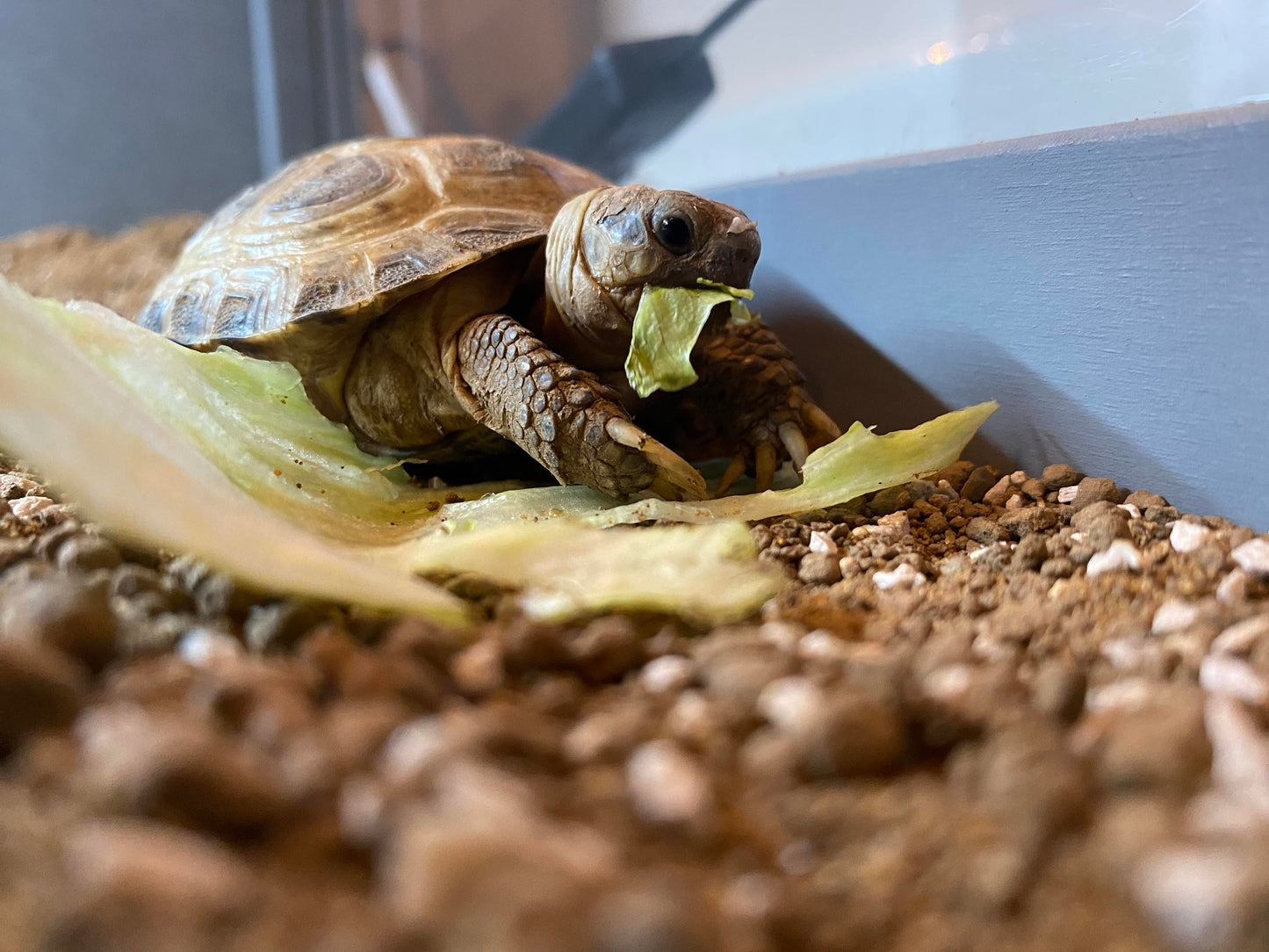
Horsfield's Testudo
Horsfield's Testudo
Out of stock
Questo prodotto non è disponibile per l'acquisto online
*** IN-STORE PICKUP ONLY!
Call for further questions
This turtle is native to Eastern Europe, in an area ranging from the southeastern Caspian Sea to western China.
Their natural habitat is made up of arid and rocky areas, near waterways where the vegetation is more lush.
There are various subspecies ( horsfieldii , baluchiorum, kazakhstanica, kuznetzovi, terbishi, rustamovi) depending on the geographical area occupied, which live in different environments, from sandy steppe to mountainous areas (up to 2500m).
To escape outside temperatures that can drop by dozens of degrees at night, these tortoises have the habit of digging tunnels (up to a couple of meters long) or occupying burrows abandoned by other animals. The subspecies that inhabit the northernmost areas hibernate for several months each year, while the southernmost ones, on the other hand, may undergo aestivation (summer inactivity due to excessively hot climates).
This species is small in size, about 15cm for males and up to 20cm for females, their carapace is rounded and flattened dorsoventrally, with a single supracaudal scutum.
The background color is yellow ochre or light brown, with black or dark brown spots in the center of each scute, depending on the subspecies; the plastron is brown or black.
The tail is equipped with a horny sheath, and has tubercles on the sides that are larger in males; it has four toes on each limb, with strong claws suitable for digging.
Males are smaller, their tail is usually longer and the plastron is concave; the anal scutes have a more open angle, and the supracaudal scute is more closed to protect the tail.
Females are larger, with the cloacal opening closer to the plastron, the anal scutes have a more acute angle and the supracaudal scute is more raised to allow the passage of the eggs.
***ATTENTION!!!
Testudo horsfieldii is listed in Appendix II of CITES (Convention on International Trade in Endangered Species of Wild Fauna and Flora).
This makes it a species commonly sold in shops, but its keeping and possession are subject to specific regulations, including the need to report it to the State Forestry Corps - CITES Service and the application of a microchip for specimens purchased after 1995.
Legislation and CITES
- CITES Appendix II : The species is included in Appendix II of CITES and in Annex B of EC Regulation 2724/2000, which regulates its trade.
- Regulations in Italy : In Italy, the surveillance and management of CITES regulations are entrusted to the State Forestry Corps.
- Reporting requirement : It is mandatory to report the possession of tortoises, including T. horsfieldii, to the CITES Service of the State Forestry Corps.
- Microchip : Since 1995, microchipping is mandatory for legal ownership. Failure to do so and not to have a microchip and CITES certification can result in seizure and criminal penalties.
Trade and possession
- Regulated trade : Since the species is not in CITES Appendix I, it is less restrictive than native tortoises such as the Hermann's tortoise.
- CITES Certificate : The sale requires a CITES certificate, which is requested by completing the appropriate form (SCT3) at the CITES Service.
- Costs : The cost of requesting the CITES certificate and installing the microchip are expenses that the owners must bear.
Share