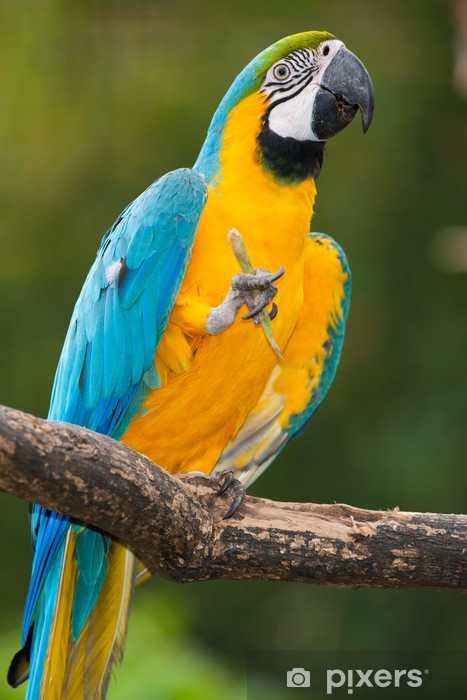
ARA ARARAUNA
ARA ARARAUNA
Low stock
Questo prodotto non è disponibile per l'acquisto online
*** IN-STORE PICKUP ONLY!
Call for further questions
The blue-and-yellow macaw, often simply called the "ararauna," is undoubtedly the best-known and most widespread macaw species: its color and size, docility and calmness make it an excellent pet but also an excellent circus juggler (in some water parks and amusement parks, in fact, these parrots are a real attraction, alone or in association with other animals).
Gold and Blue Macaw Head
It is a very beautiful animal in shape and color, long-lived and very robust and above all it is the macaw that has best lent itself to captive breeding: this is the reason for its great success among breeders and enthusiasts.
It is one of the largest parrots, measuring 86–88 cm, thanks in part to its long tail. It is also known for its longevity, living to be 70 years old or more.
The general appearance is that of a wild-formed (i.e., elongated) bird, rather strong and compact, with a good wingspan. It is indeed a good flier, but like most Psittaciformes, it enjoys climbing, using its strong legs and beak.
The head is large, slightly more massive in males (but sexual dimorphism is not evident), with a green forehead that fades to azure-blue toward the head and nape; the reins and cheeks are bare white with light black streaks, more pronounced near the eyes. The black chinstrap is prominent. The large, strong beak, again larger in males, is black. The iris of the eye is black with a yellow edge (in young birds, the color is brownish). The nape, rump, and overall upper body, including the wings and tail, are a beautiful blue-blue, while the neck, chest, belly, abdomen, and the underside of the wings and tail are a deep yellow.
The legs, short and sturdy, suitable for climbing, are dark grey in colour, like the nails.
BEHAVIOR:
Its preferred habitat is dense scrub and forest; however, it also adapts to savannahs, as long as they have large trees to shelter in. It is a calm, docile, gregarious bird, and a good mimic. In the wild, it has some competitors but very few enemies (except for humans, who are destroying its habitat). It has therefore developed a high level of sociability, enabling it to coexist well with both its own species and other species.
Its diet consists of fruit, seeds, berries, shoots, snails, and in general anything edible it finds in the trees, as it rarely goes to the ground, and reluctantly, given its clumsiness. Its strong beak allows it to eat easily even walnuts and other nuts , from which it obtains the necessary protein intake.
Nesting takes place in a tree hollow, the female lays 2-3 eggs which she incubates for 26 days: the chicks emerge from the nest after about 14 weeks and remain with their parents for the same number of weeks, who will feed and care for them carefully.
At around 6-7 months the young macaw is weaned but its sensitive period (i.e. learning period) will continue until at least 3-4 years of age, while sexual maturity will be reached around 6 years of age, females a little earlier than males.
- Documentation: In Italy, to own a specimen, you must have a CITES certificate proving that it was bred in captivity (with a permanent ring) and notify the local health authority and the Forestry Corps of your ownership.
- Conservation Status: Although still relatively common, the species is declining in the wild due to illegal trapping and habitat loss, which is why it is under CITES protection.
- In summary: If you intend to purchase or own a Blue and Gold Macaw, you must ensure that you have all the CITES documentation and comply with local Italian regulations, as it is an animal protected by international and national legislation.
Share